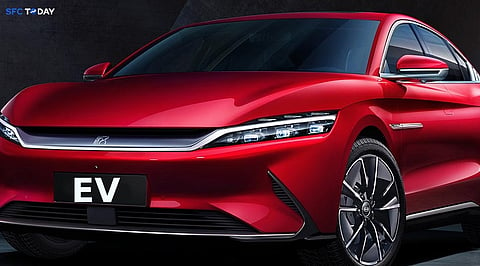


The Chinese electric-vehicle giant BYD has surged past Tesla in global battery-electric vehicle sales and is building factories across continents.
Yet, in India, one of the world’s most promising auto markets, its presence remains small, its ambitions restrained by policy roadblocks and a market that has moved faster than expected. For a company built on scale, India tells a story of limits.
BYD sold just over 5,400 vehicles in India in 2025, a tiny sliver of its global volumes. The numbers underline a structural problem: the company still relies on imports in a market that increasingly rewards localisation.
India’s cap on fully built imported cars per model and the absence of a local manufacturing base have kept prices high and volumes low. A proposed $1-billion investment plan had earlier failed to secure government clearance, reflecting tighter scrutiny of Chinese investments.
Since then, BYD has had to operate within a narrow corridor, with strong demand for its premium electric models on one side and limited supply on the other.
Dealership staff in metro cities speak of waiting periods and enquiries that do not always convert into deliveries, not because customers walk away, but because the pipeline cannot expand fast enough.
When BYD entered India’s passenger EV segment, options were few. That window has closed. Tata Motors dominates the mass market with locally made electric cars, while Mahindra and JSW-MG Motor are scaling up their own EV portfolios.
The real shift is in pricing. Models below Rs 20 lakh now drive India’s electric-car growth. BYD’s lineup, positioned in the premium category, falls outside the fastest-growing segment.
The result: even as its sales have grown in absolute terms, its rank in the EV pecking order has slipped.
For buyers, BYD represents global technology and long driving ranges. For the company, India presents a strategic dilemma: whether to commit to local manufacturing through a structure that meets regulatory requirements, or to remain a niche premium player.
Showrooms continue to attract curious customers and early adopters, a reminder that the brand’s appeal is intact. But in today’s policy environment, acceptance alone cannot build scale.
Until localisation becomes a reality, the world’s largest EV maker may continue to watch India’s electric revolution from the sidelines, present, visible, but not quite part of the surge.