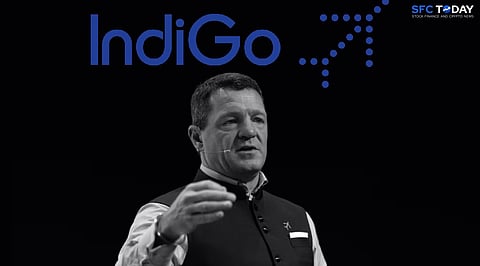


India’s largest airline, IndiGo, is going through a leadership change after CEO Pieter Elbers resigned. The airline is facing operational pressure and close checks from regulators. At the same time, passengers and investors expect better performance.
This change has started discussions in the aviation industry about how IndiGo will move forward and keep its strong position in India’s growing aviation market.
Pieter Elbers resigned as CEO of IndiGo on March 10, 2026, after leading the airline for more than three years. The company’s board confirmed that he stepped down immediately. His resignation came a few months after a major operational problem that affected many passengers across India.
In December 2025, IndiGo faced one of its biggest disruptions. From December 3 to December 5, the airline cancelled more than 2,500 flights and delayed around 1,850 flights. Over 300,000 passengers were affected at major airports in the country.
The problem was mainly linked to new pilot duty rules. India introduced new Flight Duty Time Limitation (FDTL) rules that require longer rest time for pilots. These rules were made to improve safety and reduce pilot fatigue. However, IndiGo had trouble adjusting pilot schedules quickly after the rules started.
Because of this, many flights were cancelled or delayed. Passengers in cities such as Delhi, Mumbai, Bengaluru, and Hyderabad had to wait for long hours at airports. The situation caused strong reactions on social media and raised questions about the airline’s planning and management.
● Directorate General of Civil Aviation (DGCA) checked IndiGo after many flights were disrupted.
● They looked at how the airline handled pilots, passengers, and flight operations.
● After the check, the regulator fined IndiGo ₹22.2 crore.
● The airline was also told to give a ₹50-crore bank guarantee to improve its systems and follow safety rules.
Stock impact:
● In March 2026, IndiGo’s share price closed at ₹4,383.50 on the National Stock Exchange of India.
● The stock fell over 12% in one month and over 23% in six months.
But:
● IndiGo is still India’s biggest airline.
● It has more than 60% of the domestic market and over 430 aircraft.
After Pieter Elbers resigned, IndiGo’s co-founder and Managing Director Rahul Bhatia took temporary charge of the airline. The company will now look for a new CEO in the coming months.
Rahul Bhatia has been part of IndiGo since the airline started and helped build its business. In a message to employees, he spoke about the problems that happened in December and said rebuilding passenger trust is very important.
The leadership team will now focus on making flights more reliable, improving crew schedules, and communicating better with passengers during delays or disruptions.
Despite recent difficulties, IndiGo continues to pursue strong growth plans. The airline has been expanding both within India and internationally. Its fleet mainly consists of Airbus A320 family aircraft and ATR turboprop planes used for regional routes.
The airline has also placed a large order for 60 Airbus A350-900 aircraft. Deliveries of these wide-body aircraft are expected to begin in 2027. These aircraft will allow IndiGo to operate long-distance international routes and compete more strongly with global airlines.
This expansion strategy shows that IndiGo aims to move beyond its traditional role as a domestic low-cost carrier and become a stronger global aviation player.
The next few months are very important for the airline. IndiGo needs to make sure flights run on time and operations stay smooth. Better crew planning and full compliance with aviation rules will also be very important.
At the same time, the airline must continue its growth plans while keeping good service for passengers. A strong market share, a large fleet, and a growing international network give the airline a good base for future growth.
The resignation of Pieter Elbers is a big turning point for IndiGo. The next leadership team will play an important role in deciding how the airline grows, competes, and builds its reputation in the global aviation industry.