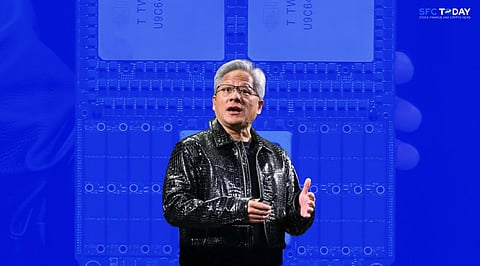


NVIDIA CEO Jensen Huang on Monday set an ambitious target for the chipmaker’s AI business. He said the company could generate up to $1 trillion in revenue from AI chip sales by 2027 as global demand for computing power accelerates.
Huang outlined the growth roadmap during his keynote at NVIDIA’s GTC 2026 conference in San Jose, where he detailed the company’s strategy across next-generation chips, rack-scale systems, space-based data centers, and autonomous mobility platforms.
Huang said cumulative purchase commitments across NVIDIA’s current Blackwell platform and its upcoming Vera Rubin systems could together reach the trillion-dollar milestone within the next two years. He pointed to the rapid pace of AI adoption globally, noting that enterprises, startups, and governments are investing heavily in large-scale training and inference infrastructure.
NVIDIA has also shortened its product refresh cycles in recent years to capture the momentum. The company is expanding its presence beyond chips by strengthening software, networking and integrated AI system offerings.
Among the major announcements, NVIDIA introduced the Groq 3 Language Processing Unit (LPU), built using technology from a startup the company largely acquired through a $20 billion asset purchase last year. The chip is designed to complement NVIDIA’s GPU ecosystem and improve AI inference speeds, with shipments expected to begin in the third quarter.
Huang also revealed Vera Rubin Space One, a project aimed at deploying data center capabilities in orbit. NVIDIA is working with satellite partner Starcloud on the initiative, with a potential satellite launch planned for November.
NVIDIA showcased a prototype of its next-generation rack architecture, Kyber, which integrates up to 144 GPUs stacked vertically to increase compute density and reduce latency. The design is expected to feature in future rack-scale systems such as Vera Rubin Ultra, likely to ship around 2027.
On the automotive front, Huang said Uber plans to roll out autonomous fleets powered by NVIDIA’s Drive AV software by 2028, starting in Los Angeles and San Francisco. Automakers, including Nissan, BYD, Geely, Isuzu, and Hyundai, are also developing Level-4 autonomous vehicles on NVIDIA’s Drive Hyperion platform.