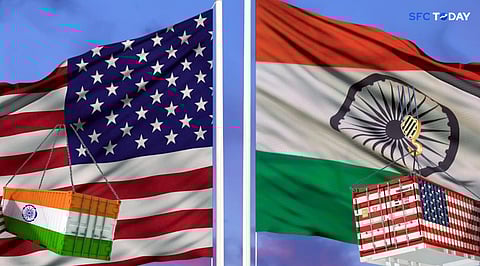


The performance of the Nifty IT index in 2026 will depend heavily on global politics, trade decisions, currency movements and technology spending by US companies. During 2025, the sector faced pressure from weaker demand in the United States and uncertainty created by new US tariff rules. As discussions about a possible India–US trade agreement gained attention toward the end of 2025, investors began to question whether such a deal could boost the Indian IT sector in the coming year.
Nifty IT started December 2025 on a weaker note. On 2 December 2025, the index traded in the mid-37,000 range, well below its previous highs. For the year, Nifty IT showed a decline in the low-teens, reflecting lower risk appetite, high valuations earlier in the year, and concerns about global demand. Technology companies rely heavily on overseas clients, especially the US market, which contributes the largest share of revenue for firms such as TCS, Infosys, Wipro and HCL Technologies. Because of this concentration, any negative news from the US immediately affects stock performance.
Throughout 2025, several economic factors created pressure on Indian markets. The United States introduced a series of tariff increases that affected global trade flows, weakened exports and raised uncertainty for companies connected to international supply chains. India’s manufacturing PMI numbers for November 2025 showed a slowdown, and analysts linked this directly to weakening demand from the US.
At the same time, the Indian rupee fell to record lows against the US dollar during the year. Although a weak rupee often helps IT exporters by increasing the value of dollar revenues, the broader currency weakness signalled capital outflows and nervousness in financial markets. As a result, IT stocks were unable to benefit fully from favourable currency movements.
Tariffs usually apply to physical goods and do not directly affect software or IT services. However, the IT industry is exposed to more specific US rules related to work visas and government procurement. These two areas can influence how cost-efficient and competitive Indian IT firms remain.
During FY2025, new H-1B visa approvals for India-based companies fell sharply, dropping to roughly 4,500–4,600 approvals. This was the lowest figure in about ten years. Such a decline limits the ability of Indian IT firms to send skilled employees to client locations in the US. When fewer employees can work onsite, project delivery becomes more expensive and less flexible. This structural challenge has been a major concern for the sector.
As a result, even though tariffs do not directly apply to IT services, visa restrictions and procurement barriers have created uncertainty for service exports.
Talks about a broad India–US trade agreement gained momentum in late 2025. Discussions included goals such as scaling bilateral trade and reducing tariff tensions. Some early reports spoke of ambitions to increase India–US trade toward the 500-billion-dollar mark by 2030.
If a trade deal includes provisions that support service exports, the impact on Indian IT companies could be meaningful. Important areas would include smoother data flow rules, better access to government procurement processes, and more predictable work-visa arrangements. Even minor improvements in these areas could boost confidence for US clients, who might feel more secure signing new long-term contracts.
Whenever news suggested progress in trade discussions, large-cap IT stocks experienced short bursts of buying interest during November 2025. This showed that markets were quick to price in optimism, even before any concrete agreement was finalized.
Nifty IT’s valuations remain a mixed picture. Many leading companies already trade at high price-to-earnings ratios, so future stock gains will need to come either from higher earnings or from renewed enthusiasm for the sector. Large companies such as TCS, Infosys and HCL Technologies dominate the index, so any recovery in 2026 will mostly be driven by these firms.
Historically, December has often been a favourable month for the index due to global fund flows and seasonal business patterns. However, seasonal trends alone cannot generate a sustained recovery. Strong demand from the US and improved policy clarity remain more important.
Even if trade negotiations progress smoothly, several risks could limit a strong rebound for Nifty IT. Continued protectionist measures in the US, new restrictions on skilled-worker visas, and unstable foreign investment flows can all keep valuations under pressure.
The Reserve Bank of India is expected to ease interest rates in 2026, which could boost domestic sentiment. A more stable rupee would also help IT companies plan operations better. But the real deciding factor will be US companies’ technology budgets. If American firms delay digital transformation or cloud-migration projects due to economic uncertainty, demand for outsourcing services could slow down, regardless of any trade deal.
Two main scenarios exist for 2026. If the India–US agreement focuses mainly on reducing tariffs on physical goods, the immediate benefit to IT may be limited. Manufacturing sectors would gain more in such a case. However, if the final agreement includes commitments that protect and encourage service exports — such as clear rules for talent mobility, procurement access and digital trade — then Nifty IT could see a strong revival.
Under a supportive trade framework, the sector could benefit from higher client confidence, improved margins and greater visibility on long-term projects. Without these elements, any recovery may be temporary and vulnerable to sudden policy changes.
A revival of Nifty IT in 2026 is possible, but not guaranteed. The sector will depend on a combination of improved US demand, stable currency conditions, better visa policies and favourable trade terms. Market watchers will look for three major signals: specific trade-deal language supporting services, trends in H-1B approvals, and clear signs of rising IT spending by US companies. If these align, the index could enter a stronger phase in 2026. If they do not, the sector may continue to face the same challenges that held it back in 2025.