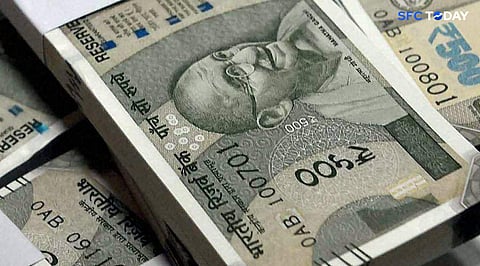


The Indian rupee is entering FY26 under heavy pressure, with currency markets increasingly pricing in a prolonged period of weakness. After repeatedly touching record lows in late 2025, the rupee has struggled to recover in a meaningful way. Several economic, financial and global factors suggest that this pressure may not be temporary. Instead, the rupee could remain Asia’s weakest-performing currency through FY26.
In mid-December 2025, the rupee crossed the ₹90 per U.S. dollar level for the first time, forcing the Reserve Bank of India to intervene aggressively in both spot and forward currency markets. While this intervention helped slow the pace of depreciation, it did not reverse the underlying trend. The need for repeated intervention itself highlights the depth of the problem. Currency support measures can smooth volatility, but they cannot permanently offset structural imbalances.
Markets increasingly view RBI intervention as defensive rather than decisive. Each intervention episode temporarily stabilises the rupee, but selling pressure tends to return once dollar demand rises again. This pattern suggests that FY26 could see continued bouts of volatility, with the rupee remaining biased toward weakness.
One of the biggest reasons for rupee weakness is fragile foreign capital flows. Foreign institutional investors have been steadily pulling money out of Indian equities and bonds during periods of global uncertainty. Profit booking, portfolio rebalancing and risk-off sentiment have all contributed to sustained outflows since late 2024.
By the end of 2025, speculative short positions against the rupee had risen sharply. This means many traders are actively betting on further depreciation. When bearish positioning becomes crowded, even small negative triggers can cause sharp currency moves. As long as foreign inflows fail to return consistently, the rupee remains vulnerable to both fundamentals and market sentiment.
India’s current account deficit widened significantly in the second quarter of FY26. Higher imports, particularly energy-related, combined with slower export growth, pushed the deficit higher than market expectations. A larger current account deficit means India needs more foreign capital to finance trade and payments.
When global capital is easily available, this is less of a problem. However, in an environment of tighter global liquidity, funding a wider deficit becomes challenging. Any slowdown in foreign investment immediately puts pressure on the rupee. This external imbalance is one of the main reasons currency strategists expect the rupee to underperform many Asian peers in FY26.
India’s foreign exchange reserves have declined from their recent peak levels during 2025. Although reserves remain large in absolute terms, the trend has shifted. Continuous intervention to defend the rupee has led to a steady drawdown, reducing the buffer available to manage prolonged stress.
Markets closely track reserve levels as a signal of how much firepower the central bank has. As reserves fall, the cost of defending the currency rises. This creates a situation where the RBI may tolerate gradual depreciation rather than aggressively fight market forces. That approach supports stability but also allows the rupee to weaken over time.
Global monetary conditions remain unfavourable for emerging market currencies. Even as inflation has cooled in some developed economies, uncertainty around U.S. interest rate cuts continues. Any delay in Federal Reserve easing keeps U.S. yields elevated, supporting a strong dollar.
Higher U.S. yields attract global capital into dollar assets, reducing appetite for emerging market currencies like the rupee. Interest rate differentials between India and the U.S. have narrowed in real terms, weakening the rupee’s carry appeal. Unless the global rate cycle clearly turns supportive, FY26 is likely to remain challenging for the currency.
India remains a major importer of crude oil and other commodities. Elevated global commodity prices directly increase the import bill, worsening the trade balance and increasing dollar demand. Even short-term spikes in oil prices can quickly impact the rupee.
Seasonal trade factors also play a role. Periods of higher import payments, corporate dollar repatriation and overseas debt servicing tend to create recurring pressure points. These cyclical factors, combined with structural trade deficits, make sustained rupee strength difficult to achieve.
Policy options to strengthen the rupee are constrained. Raising interest rates purely to defend the currency could hurt domestic growth and investment. Fiscal measures to reduce the trade deficit take time to show results. Structural reforms that boost exports and long-term capital inflows are important but do not provide immediate relief.
As a result, authorities are likely to focus on managing volatility rather than targeting a specific exchange rate level. This approach reduces the risk of sharp disorderly moves but allows gradual depreciation to continue.
Several Asian currencies have shown relative resilience due to stronger trade balances, lower dependence on portfolio flows or earlier policy adjustments. In contrast, India’s combination of a widening current account deficit, declining reserves and heavy reliance on foreign portfolio capital leaves the rupee more exposed.
By December 2025, the rupee had clearly underperformed most Asian peers, reinforcing its position as the region’s weakest currency. Without a strong shift in global conditions or domestic balances, this relative weakness is likely to persist through FY26.
For the rupee to regain strength, multiple factors would need to align: sustained foreign inflows, narrowing of the current account deficit, stabilisation of forex reserves and a clear turn toward lower global interest rates. Until then, the balance of risks remains tilted toward weakness.
Given existing data trends and market behaviour, FY26 is shaping up to be another difficult year for the Indian rupee, with depreciation pressures likely to persist even if sharp declines are periodically contained.