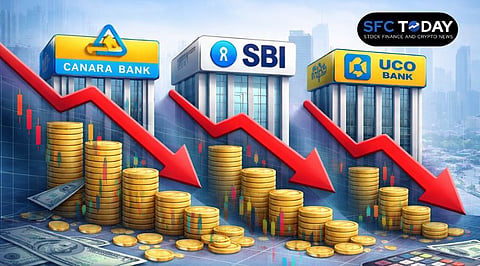

PSU bank stocks, including Canara Bank, SBI, and UCO Bank, fell up to 5% as bond yields surged sharply. It has impacted investor sentiment and raised concerns over banking sector profitability and valuation in a volatile market environment.
This becomes more significant in an environment where yields are expected to remain elevated amid higher government borrowing and a reduced likelihood of policy rate cuts.
Bank of Baroda, Canara Bank, Punjab National Bank, and UCO Bank were among the PSU lenders that witnessed heavy selling in Friday’s session (March 27).
Bank of Baroda emerged as the top laggard, falling 4.8% to Rs. 259.5 apiece. It was followed by Canara Bank, Punjab National Bank, Punjab & Sind Bank, and UCO Bank, all of which declined over 4%.
Other lenders, including Indian Bank, Central Bank of India, Bank of India, Union Bank of India, Indian Overseas Bank, State Bank of India, and Bank of Maharashtra, fell between 2% and 3.5%.
The Indian 10-year bond yield surged to 6.9%, extending gains to its highest level since July 2024. It is followed by a combination of fiscal pressures, energy shocks, and heavy debt supply, that pushed borrowing costs higher.
Additionally, the recent excise duty cut on petrol and diesel has heightened concerns over the fiscal deficit and long-term fiscal sustainability, further raising investor anxiety.
The PSU banking pack, which emerged as a top performer in 2025, has lost momentum in recent weeks. Seven of the 15 constituents of the Nifty PSU Bank index have declined between 10% and 21% so far in 2026.
Punjab & Sind Bank has fallen the most, down 21% to Rs. 21.87. UCO Bank, Canara Bank, and Punjab National Bank have dropped over 15% each during the same period. Meanwhile, Bank of Baroda, Central Bank of India, and Indian Overseas Bank have declined more than 10%.
US President Donald Trump said he would extend the pause on potential attacks on Iran’s energy infrastructure by 10 days, adding that talks with Tehran had gone “very well.” This follows his earlier decision to halt strikes for five days.
While rising bond yields may have a limited direct impact on banks’ net interest margins, they could weigh on treasury performance. Higher yields typically lead to mark-to-market losses on available-for-sale and trading portfolios, creating volatility in treasury income.
The prolonged conflict has rattled global markets and fuelled fears of higher inflation and slower economic growth.
The Nifty PSU Bank index dropped sharply by 3.6% to an intraday low of 8,266. The decline has dragged the index down about 3% so far in 2026 and nearly 17% from its recent peak.